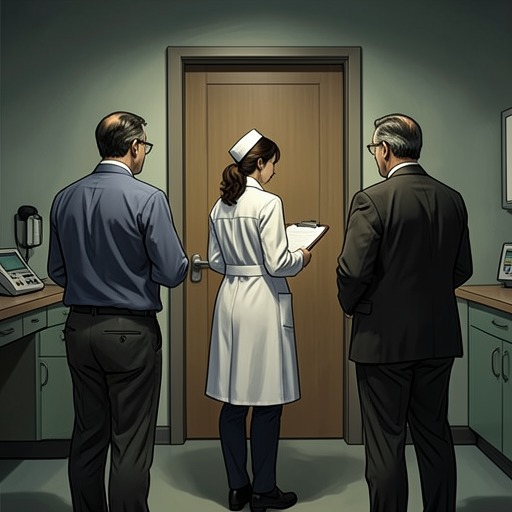
Nancy Doherty
The Good Nurse: A True Story of Medicine, Madness, and MurderNancy Doherty, an assistant pharmacist at Somerset Medical Center, becomes the hospital’s crucial but constrained point of contact with New Jersey Poison Control Center during an inquiry into patients’ unexplained drug levels. Asked to obtain help with the calculations behind Reverend Florian Gall’s digoxin results, she brings Bruce Ruck information that changes the apparent scale of the problem: Gall’s levels rose after his medication had stopped, and earlier patients had suffered insulin overdoses. Her role is not that of a police investigator; it is to carry a question from an internal review to an outside specialist, then decide how much of what she knows she can disclose and to whom.
Pharmacy Assignment and Initial Call
The inquiry begins as an internal effort to understand deaths associated with digoxin. Somerset Medical Center plans to review Pyxis records around the dates of the deaths, while Doherty is assigned to contact New Jersey Poison Control Center and ask how much digoxin could account for the concentrations found in Gall’s blood. The assignment is framed narrowly: pharmacy needs help with the arithmetic, not a broader outside investigation.
On July 7, 2003, Doherty calls the poison center from the hospital pharmacy. She identifies herself and explains that the case is not happening in real time but concerns a patient’s earlier digoxin toxicity. Her hesitant introduction marks the distance between the formal purpose of the call and the troubling event behind it: she is seeking technical advice about a patient who has already become a case under review.
When she speaks with Ruck, she gives him the chronology. One patient had coded in the Cardiac Care Center on June 16 with excessive digoxin levels; another, Gall, had suffered digoxin toxicity in the same unit on June 28. The recurrence of the same drug problem in the same unit makes the pattern harder to treat as a single isolated episode. Ruck responds with alarm, and Doherty sounds relieved that another pharmacist recognizes the seriousness of what she is describing.
Gall’s Results and the Expanding Pattern
Doherty reads Gall’s laboratory values from the reports: the levels were 1.2 on June 20 and 1.08 on June 22, rose to 1.59 and then 1.33, and reached 9.61 just after dawn on June 28. Asked when Gall received his next digoxin dose after the level of 1.33, she answers that he never received another. The rise therefore occurred a full day after doctors had taken him off the medication. The numbers give Ruck a concrete basis for asking when Gall might have received the drug and how much would be needed to produce the spike.
The consultation has been presented as a request for calculations, but the evidence begins to pull it toward a different kind of inquiry. Doherty says that Mary Lund and medical director William Cors have spoken with her and need calculations that might connect the digoxin spike to the nursing schedule. The requested result is a curve: an estimate of the time and quantity that could account for the blood levels. The technical task is thus tied to the question of what happened on the unit, even as the hospital has not yet openly treated the matter as a police investigation.
Ruck’s questions also bring forward information Doherty has not volunteered at the outset. She tells him there were two more patients before Gall. These were insulin overdoses, and she and Marty Kelly, the nurse practitioner who first alerted risk manager Lund, had panicked when they saw the figures. Doherty had tried to keep the hypoglycemic cases separate from the digoxin calculations. In her account, the call was supposed to be a neutral resource for working out the drug math; Ruck’s recognition that the insulin episodes belonged to the same troubling picture makes that separation difficult to maintain.
Disclosure, Caution, and Institutional Control
As Ruck warns that delay could expose the hospital to public blame if the cases prove to be police matters, Doherty says her superiors do not know that she has told him about the hypoglycemic episodes. She does not simply hand the inquiry over. Instead, she asks Ruck not to come to Somerset and says she will brief Cors and Lund herself. She promises a callback. Her decision keeps the next step within the hospital’s chain of authority, while making clear that the information has already crossed its intended boundary: an outside poison specialist now knows about the earlier insulin cases.
The call also places Doherty between different professional responsibilities. She has been assigned to help her hospital understand drug levels, yet the details she shares suggest a pattern that cannot be contained within a calculation alone. The text does not present her as the person who determines whether the events are criminal or who controls the institution’s response. Rather, she is the person in the conversation who has both the laboratory chronology and knowledge of the earlier insulin episodes, and who must decide how to transmit that knowledge under conditions of uncertainty and hierarchy.
When Somerset does not call back, Ruck contacts the pharmacy again. He learns from Stuart Vigdor, the head of pharmacy and Doherty’s boss, that the administration has taken over the investigation. The change in control is significant: the inquiry that began with pharmacy reviewing medication records and seeking calculations has become an administrative matter. Later, Ruck calls again and asks to speak with Doherty; the call is put through to her. The available account does not specify what she says in that subsequent conversation, but her return as the contact person underscores her position at the junction of the pharmacy staff, hospital leadership, and outside poison-control expertise.
Narrative Role and Significance
Doherty’s importance lies in the information she conveys and in the limits placed around that exchange. Her first task sounds technical and circumscribed: estimate the drug exposure behind Gall’s laboratory results. The dates and values she gives Ruck make the problem concrete, while her admission of two earlier insulin overdoses widens it beyond the single digoxin case. A call intended to clarify dosage thus becomes a disclosure of recurring, unexplained patient harm.
The contrast between the precision of the lab figures and the caution of the institutional conversation shapes her role. She can report that Gall’s digoxin level climbed to 9.61 after the drug had been discontinued; she can tell Ruck that insulin overdoses came before the digoxin cases; and she can ask that her own superiors be briefed before an outside specialist comes to the hospital. But the administration’s subsequent takeover shows that the decisions about the inquiry’s direction do not rest with her. Doherty is neither a detached source of numbers nor an all-powerful whistleblower. She is a working pharmacist whose ordinary assignment becomes a narrow channel through which a much larger pattern begins to surface.